
Nattokinase Powder vs Capsules: Why a Drink Mix Beats a Standard Capsule
Table of Contents
- Quick Answer
- Nattokinase Drink Mix vs Standard Capsule: At a Glance
- First, the Problem: Nattokinase Doesn't Like Acid
- What Happens to a Nattokinase Capsule in Your Stomach
- What Happens to a Nattokinase Drink Mix: It Leaves With the Water
- Your Glass of Water Has a Second Job: Turning Down the Acid
- Why Every Minute in Acid Counts
- What We're Not Claiming
- Why Toku Flow Is a Nattokinase Drink Mix, Not a Capsule
- FAQs
- References
Quick Answer
Nattokinase powder is dissolved in water, so it spends far less time in stomach acid than a standard nattokinase capsule — and less time soaking in acid means more of the enzyme's activity survives the trip to your intestine, where it gets absorbed.
- Nattokinase is a protein, and your stomach's whole job is destroying proteins — with strong acid plus a protein-shredding enzyme called pepsin
- Dissolved nattokinase powder leaves with the water: half is out of an empty stomach in about 13 minutes, and it's essentially all gone by 45 (measured by MRI)
- A capsule is a solid, so it waits for a cleanup sweep your stomach runs roughly every two hours — 74 minutes in acid on average, and up to 4 hours
- The glass of water helps twice: for the first few minutes it also dilutes your stomach acid, cutting pepsin to about a third of its strength while the enzyme is most exposed
- Lab research shows acid damage to nattokinase becomes permanent with time — so the minutes your format saves are what protect the enzyme
Here's the thing almost nobody mentions when you're shopping for a nattokinase supplement: nattokinase is a protein. And your stomach exists to destroy proteins. It does that with strong acid and a protein-shredding enzyme called pepsin — the same machinery that takes apart a steak, and it doesn't care that your supplement was expensive. So when you compare nattokinase powder dissolved in a glass of water against a standard capsule, the real question isn't which one is more convenient. It's this: how long does the enzyme soak in stomach acid before it escapes to your small intestine — the place where research shows nattokinase actually gets absorbed (Kurosawa et al., 2015)?
A capsule soaks. A drink mix flushes. That's the whole story and every number below comes from published imaging and lab research.
Nattokinase Drink Mix vs Standard Capsule: At a Glance
| Nattokinase Drink Mix | Standard Nattokinase Capsule | |
|---|---|---|
| When you swallow it | Already dissolved — nothing left to break down | A solid — the shell has to dissolve before anything is released |
| How it leaves your stomach | Flows out with the water, starting immediately | Waits for a cleanup sweep that comes roughly every 2 hours |
| Time in stomach acid (measured) | Half gone in ~13 minutes; essentially all gone by ~45 | 74 minutes on average |
| Worst case | Slower by a few minutes | Up to 240 minutes — four hours |
| Acidity around the enzyme at first | Briefly diluted above pH 4 — pepsin at about a third of its strength | Full-strength acid (about pH 1.7) — pepsin near full power |
| How the enzyme is spread out | Evenly, through the whole glass | Dumped as one concentrated clump wherever the capsule sits |
| Can it get stuck? | No — liquids don't get stuck | Yes — capsules can lodge in the folds of the stomach lining and miss the sweep |
| Predictability of Dosing | High | Low — you can't know what digestive timeline you're getting |
Sources: Mudie et al., 2014, Grimm et al., 2018, Karamanolis et al., 2008, Dressman et al., 1990, Worthington Enzyme Manual, ScienceDirect: Gastric Residence Time
First, the Problem: Nattokinase Doesn't Like Acid
Nattokinase is an enzyme — a working protein — made by a bacterium called Bacillus subtilis during fermentation. Like most enzymes, it only works while it holds its folded shape, and it's picky about its surroundings. Lab testing shows nattokinase is most stable near neutral pH, roughly pH 6 to 9, and loses activity quickly in acid (Yang, 2015). (Quick refresher: pH is the acidity scale. 7 is neutral, and lower numbers mean more acidic.) A review of nattokinase delivery research puts it bluntly: the enzyme is sensitive to stomach acid and gets broken down by acid and pepsin on its way through the digestive tract (Food Structure, 2021).
Now the bad news. Your empty stomach sits at a median pH of about 1.7 (Dressman et al., 1990) — nowhere near this enzyme's comfort zone. And the acid isn't even the whole problem. Pepsin, the stomach's dedicated protein-shredder, is at its best in exactly that environment: it runs at roughly 90% of its maximum power at pH 1.5, but only about 35% at pH 4.5 (Worthington Enzyme Manual).
Worse, the two work as a team. Research describes a one-two punch: acid unfolds the enzyme's structure first, and the unfolding exposes fresh spots for pepsin to cut (Food Structure, 2021). Acid opens the protein. Pepsin shreds it. Both steps take time — which is exactly why the format you swallow matters so much.
Key finding: An empty stomach sits at about pH 1.7 — an environment where pepsin runs near 90% of its full power and nattokinase is far outside its stable range. Every extra minute the enzyme spends there works against it.
(New to this enzyme? Start with How Nattokinase Works: The Science Behind the Enzyme.)
What Happens to a Nattokinase Capsule in Your Stomach
Your stomach doesn't drain like a sink. Liquids flow out continuously, starting almost right away. Solids are treated completely differently: between meals, they wait for a scheduled cleanup sweep. Scientists call the schedule the migrating motor complex — a cycle of stomach contractions that repeats roughly every two hours (Deloose et al., 2012) — and they call the sweep itself the "housekeeper wave," because that's genuinely what it does: it's the cleanup crew that comes through and clears out whatever is still sitting there. Imaging studies in people confirm that solid objects leave the stomach on that cleanup schedule — not with the liquid they were swallowed with (Coupe et al., 1991).
So here's a capsule's actual itinerary:
- It lands in full-strength acid. The water you swallowed it with empties fast. The capsule stays behind.
- The shell has to dissolve before any enzyme is released at all.
- The powder dumps out as a clump, right where the capsule happens to be sitting — not spread through a glass of fluid.
- Then it waits for the bus. Swallow a capsule just before a housekeeper wave and it might leave quickly. Swallow it just after one, and it can sit through most of a two-hour cycle. And there's one more wrinkle: research shows small, dense objects can get caught in the folds of the stomach lining and miss the sweep entirely — meaning they wait for the next one (Gastric emptying of non-disintegrating solid drug delivery systems).
Add it all up, and here's the measured result: the average capsule spends 74 minutes in stomach acid, and the observed range runs from 0 to 240 minutes (ScienceDirect: Gastric Residence Time).
Key finding: The average capsule spends 74 minutes in stomach acid, and the measured range runs from 0 to 240 minutes (ScienceDirect). Four hours is on the table — and you can't know which draw you're getting.
To be fair, none of this is a defect of any particular brand. It's simply how stomachs treat solid objects. But it's also exactly why "which format?" deserves far more attention than it usually gets.
What Happens to a Nattokinase Drink Mix: It Leaves With the Water
Nattokinase powder stirred into water is dissolved before you ever swallow it. That one fact changes the entire trip.
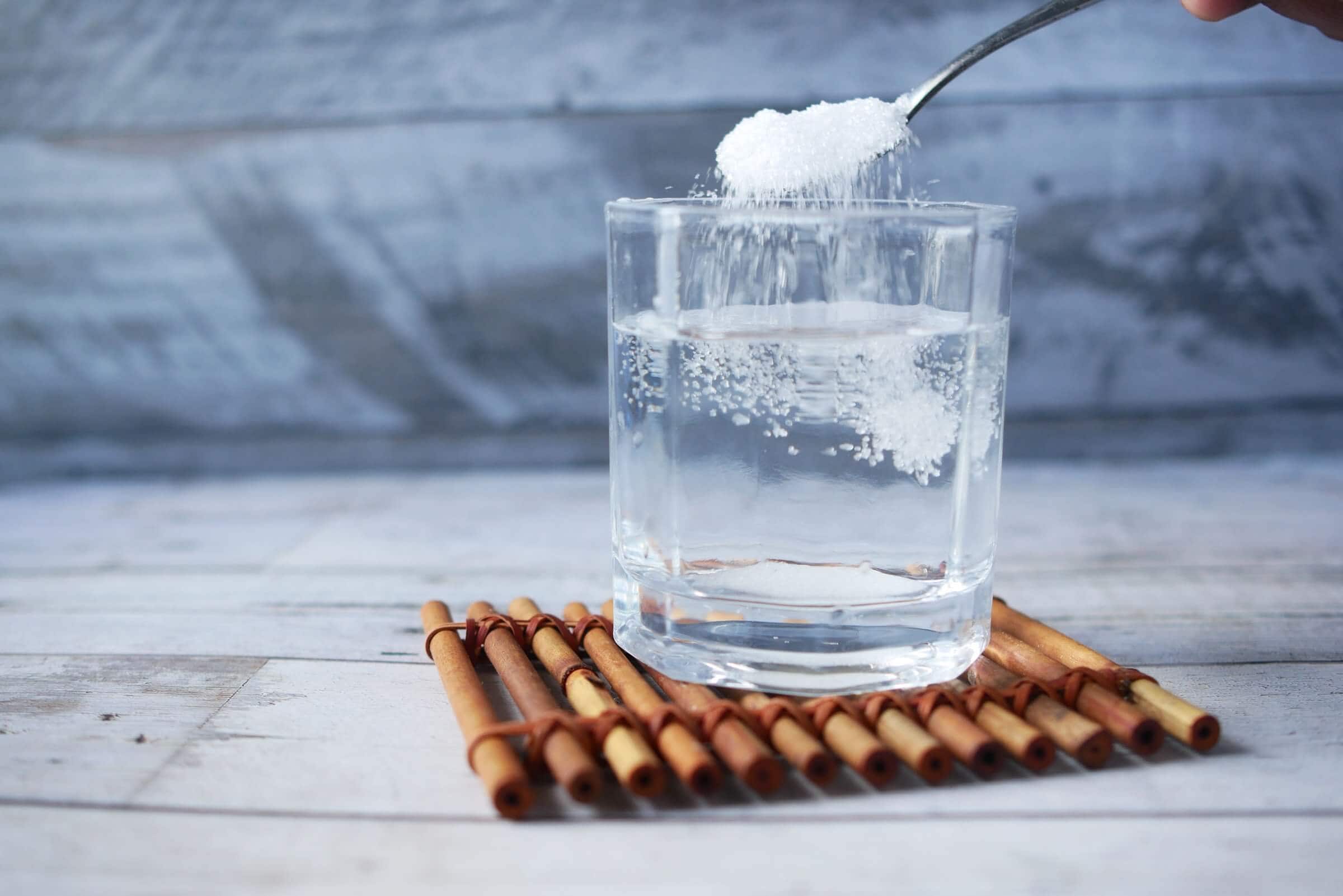
Think of a sugar cube versus sugar stirred into water. The cube sits at the bottom of the glass. The stirred sugar is everywhere in the water, instantly, and it goes wherever the water goes. A drink mix is the stirred sugar: no shell to dissolve, no clump, nothing to wait for. The enzyme rides out with the water — and the water leaves fast.
How fast? This has been measured directly, in real people, with MRI. Researchers tracked an 8-ounce (240 mL) glass of water in twelve people with empty stomachs: half the water was gone in about 13 minutes, and the stomach was back to its resting baseline within 45 (Mudie et al., 2014). A separate MRI study found 85% of the stomach's fluid emptied within 30 minutes (Grimm et al., 2018).
And this isn't only an empty-stomach story — though an empty stomach is still the best way to take it (more on that below). Even with food in there, liquids find a fast lane out: researchers have described a pathway nicknamed the Magenstraße — German for "stomach road" — that channels liquids past solid food toward the intestine in about 10 minutes (Pal et al., 2007), and MRI work found water leaves a full stomach about as fast as an empty one (Grimm et al., 2017).
Key finding: MRI studies show half a glass of water leaves an empty stomach in about 13 minutes, and it's essentially all gone by 45 (Mudie et al., 2014). Dissolved nattokinase powder rides out with it — while the average capsule is still sitting in acid at 74 minutes.
Your Glass of Water Has a Second Job: Turning Down the Acid
Here's the part almost nobody talks about: when you dissolve nattokinase powder in water, the water isn't just the vehicle. For a few minutes, it changes the stomach itself.
In a study of twelve healthy people, drinking a 200 mL glass of water raised stomach pH above 4 within one minute — in 10 of the 12 — and kept it there for about three minutes (Karamanolis et al., 2008). The water dilutes the acid and even buffers it a little on its own.
Three minutes doesn't sound like much — until you remember the pepsin numbers from earlier. Above pH 4, pepsin runs at roughly a third of its full strength instead of nearly all of it. So the dissolved enzyme spends its first and most vulnerable minutes in a stomach that's watered down, briefly less acidic, and running its protein-shredder on low — while it's already heading for the exit. A capsule can't use that window: by the time its shell breaks down, those minutes are typically long gone, and so is the water.
Key finding: A glass of water lifts stomach pH above 4 within one minute (Karamanolis et al., 2008), cutting pepsin to roughly a third of its strength — exactly when the dissolved enzyme needs the protection most.
Why Every Minute in Acid Counts
Acid damage to this enzyme works like a soak, not a switch. A quick dip in something harsh is survivable. A long soak is a different story.
There's a lab study that shows this directly. Researchers held crude nattokinase in acid at pH 3, then brought the pH back to neutral at different time points. When the acid exposure lasted less than about an hour, the enzyme's activity could still be restored. Past an hour, the damage was permanent (Yang, 2015).
Two honest footnotes before you run with that number. The experiment used pH 3 — noticeably gentler than the roughly 1.7 of a real empty stomach — and it had no pepsin in it. Real stomach fluid is harsher on both counts, so the true window is probably shorter than an hour. But notice that both footnotes point the same way: the less time in acid, the more activity the enzyme keeps.
Now line the two formats up against that clock. The drink mix is half out of the stomach in about 13 minutes and essentially done by 45 (Mudie et al., 2014). The capsule averages 74 minutes — already past the window that lab study measured — and can go as long as four hours (ScienceDirect). One format's exposure is a handful of minutes, reliably. The other's is over an hour on average, and it's a lottery.
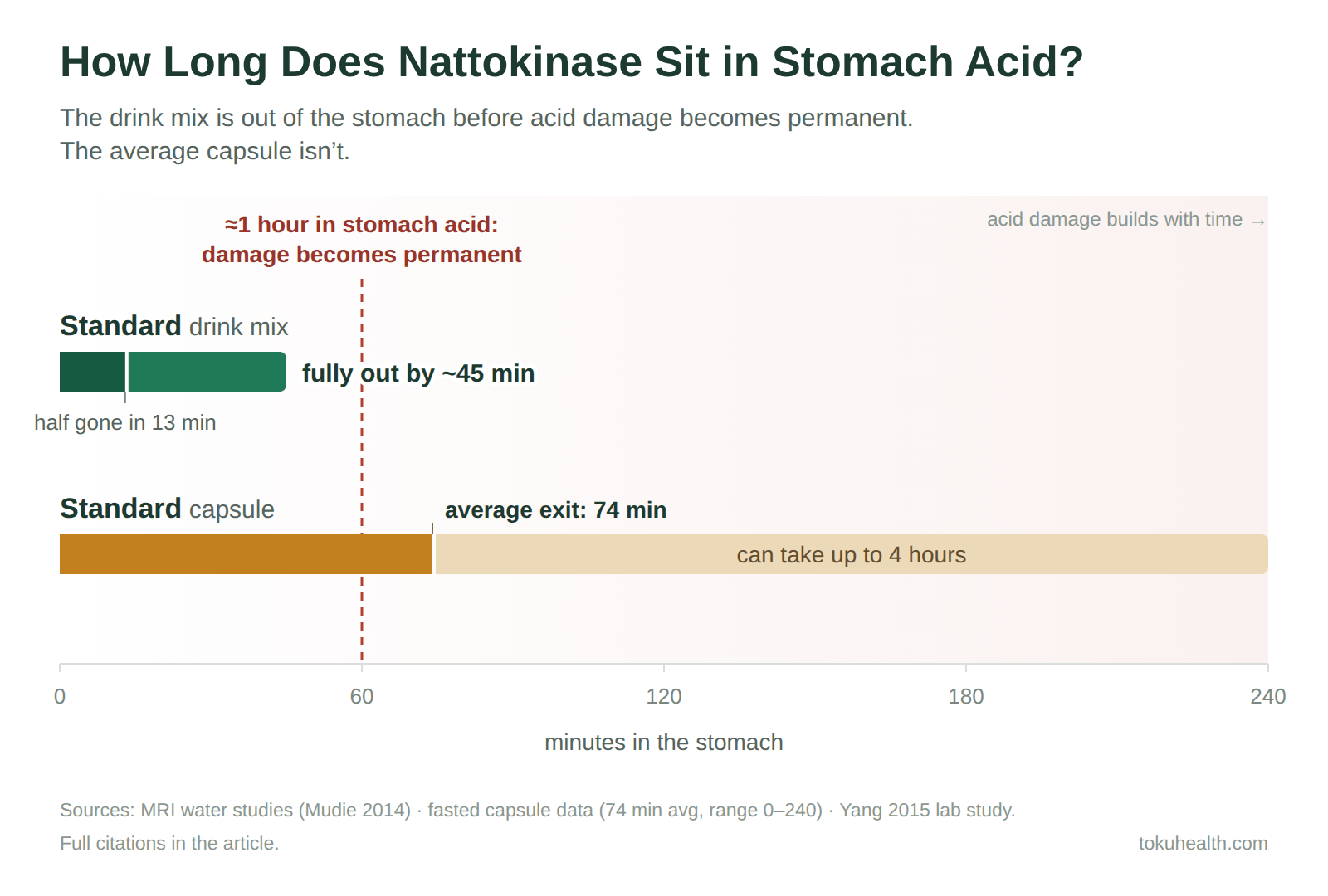
Key finding: Acid damage to nattokinase builds with time, and lab data suggest it eventually becomes permanent. Less time in acid means more of the enzyme's activity survives — and time in acid is exactly what the format decides.
What We're Not Claiming
At this point you might expect a line like "capsules destroy 90% of the enzyme." You won't find one here, for a simple reason: nobody has published that measurement.
As far as we know, no published study has directly measured how much enzyme activity survives a drink mix versus a capsule, head to head. What has been measured — thoroughly — is everything above: how fast liquids and solids leave the stomach, what a glass of water does to stomach acidity, how strong pepsin is at each pH, and how nattokinase holds up in acid over time. That's a strong case built on real numbers, but it's a case about exposure, not a survival percentage. If you ever see a brand quote a precise survival number without published data behind it, be skeptical.
And to be completely clear: capsules aren't useless. Clinical research on orally taken nattokinase shows measurable activity in the body (Kurosawa et al., 2015) — the enzyme clearly can make it through. Our point is narrower: dissolved nattokinase powder simply spends far less time in a gentler stomach, with far less luck involved. For an acid-sensitive enzyme whose damage builds with time, that's the thing worth controlling.
Related reading: How Nattokinase's Fibrinolytic Activity Works — and Why It Matters for Heart Health
Why Toku Flow Is a Nattokinase Drink Mix, Not a Capsule
Everything above is stomach physiology. Here's how it shaped our product.
We started with the dose. The clinically studied dose of nattokinase is 10,800 FU per day — the amount used in the largest nattokinase trial, which followed 1,062 people for 12 months and found that a lower 3,600 FU dose didn't work (Chen et al., 2022). Most capsules contain 2,000 FU, so matching the studied dose with capsules means swallowing several of them every single day — and roughly 40% of Americans have trouble swallowing pills at all. (The full dosing story is here: Nattokinase Dosage Guide: Why 2,000 FU May Not Be Enough.)
Then we picked the format that protects that dose. Toku Flow delivers the full 10,800 FU as a drink mix — nattokinase powder that dissolves in a glass of water — so the enzyme arrives in your stomach the way the research above describes: dissolved, diluted, and already moving.
How to take it, straight from the studies above: stir it into a full glass of water — 8 ounces, about 240 mL, the same volume the MRI and pH studies used — and ideally drink it on an empty stomach, but consistency matters the most so don't fret too much if you need to take it with a meal. For more on timing, see The Best Time to Take Nattokinase.
One more thing, because we keep our science and our sales separate: everything on this page is about delivery — getting the enzyme through your stomach with as little acid time as possible. What nattokinase itself does in the body is its own well-studied topic, covered with citations in our guide to what nattokinase is and what the research shows.
FAQs
Is nattokinase powder better than capsules?
On the two things researchers can actually measure — time in stomach acid and predictability — dissolved nattokinase powder has the clear edge. It leaves the stomach with the water it's stirred into (half gone in about 13 minutes, essentially all gone by 45), and it spends its first minutes in a stomach the water has briefly made less acidic, where pepsin runs at about a third of its strength. A standard capsule averages 74 minutes in full-strength acid and can take up to four hours. No study has measured head-to-head enzyme survival between the formats yet, but for an acid-sensitive enzyme, less time in acid means more retained activity.
How long does a nattokinase capsule stay in your stomach?
About 74 minutes on average on an empty stomach — but the measured range runs from 0 to 240 minutes. Capsules are solids, so they wait for a cleanup sweep (the housekeeper wave) that your stomach runs roughly every two hours. When a capsule leaves depends on where in that cycle it happened to land, and capsules can even get caught in the folds of the stomach lining and miss a sweep entirely.
Does stomach acid destroy nattokinase?
It can — given enough time. Nattokinase is most stable near neutral pH (about 6 to 9) and gets broken down by the combination of stomach acid and pepsin. The damage builds with time: in lab testing, enzyme activity lost at pH 3 could still be recovered if the acid was neutralized within about an hour, but became permanent after that. That's why how long the enzyme sits in acid — which the format decides — matters more than any single number.
Should I take nattokinase powder on an empty stomach?
On an empty stomach, dissolved nattokinase powder gets the fastest, most predictable exit — MRI studies show half a glass of water is gone in about 13 minutes. Taking it near food isn't a failure (liquids still find a fast lane out of a full stomach), but an empty stomach keeps both the transit and the acidity working in your favor. First thing in the morning or between meals works well.
How much water should I mix nattokinase powder with?
A full glass — 8 ounces (about 240 mL) or more. That's the amount the imaging and pH studies actually used, and it does three jobs at once: it dilutes your stomach acid, briefly lowers the acidity enough to calm pepsin down, and carries the dissolved enzyme out on the fast liquid-emptying curve. A small splash of water does less of all three.
Can I open a nattokinase capsule and stir it into water?
In theory, a dissolved enzyme rides the same fast exit no matter where the powder came from. In practice, capsule contents aren't built for it: many contain filler carriers like maltodextrin, they aren't flavored or made to dissolve cleanly, and most capsules hold only about 2,000 FU — so you'd need several just to approach the clinically studied 10,800 FU dose. A purpose-built nattokinase drink mix solves the format and the dose in one step.
References
- Mudie DM, Murray K, Hoad CL, et al. Quantification of Gastrointestinal Liquid Volumes and Distribution Following a 240 mL Dose of Water in the Fasted State. Molecular Pharmaceutics. 2014;11(9):3039-3047.
- Grimm M, Koziolek M, Kühn JP, Weitschies W. Interindividual and intraindividual variability of fasted state gastric fluid volume and gastric emptying of water. European Journal of Pharmaceutics and Biopharmaceutics. 2018;127:309-317.
- Grimm M, Scholz E, Koziolek M, Kühn JP, Weitschies W. Gastric Water Emptying under Fed State Clinical Trial Conditions Is as Fast as under Fasted Conditions. Molecular Pharmaceutics. 2017;14(12):4262-4271.
- Pal A, Brasseur JG, Abrahamsson B. A stomach road or “Magenstrasse” for gastric emptying. Journal of Biomechanics. 2007;40(6):1202-1210.
- Karamanolis G, et al. A Glass of Water Immediately Increases Gastric pH in Healthy Subjects. Digestive Diseases and Sciences. 2008;53(12):3128-3132.
- Dressman JB, Berardi RR, et al. Upper gastrointestinal (GI) pH in young, healthy men and women. Pharmaceutical Research. 1990;7(7):756-761.
- Deloose E, Janssen P, Depoortere I, Tack J. The migrating motor complex: control mechanisms and its role in health and disease. Nature Reviews Gastroenterology & Hepatology. 2012;9(5):271-285.
- Coupe AJ, et al. Correlation of the gastric emptying of nondisintegrating tablets with gastrointestinal motility. Pharmaceutical Research. 1991.
- Gastric emptying of non-disintegrating solid drug delivery systems in fasted state: relevance to drug dissolution.
- Gastric Residence Time — an overview. ScienceDirect Topics.
- Pepsin. Worthington Enzyme Manual. Worthington Biochemical Corporation.
- Yang Y. Study on the enzymatic properties of Nattokinase. Proceedings of ICIMM 2015. Atlantis Press.
- Research progress on the utilisation of embedding technology and suitable delivery systems for improving the bioavailability of nattokinase: a review. Food Structure. 2021;30:100219.
- Chen H, Chen J, Zhang F, et al. Effective management of atherosclerosis progress and hyperlipidemia with nattokinase: A clinical study with 1,062 participants. Frontiers in Cardiovascular Medicine. 2022;9:964977.
- Kurosawa Y, Nirengi S, Homma T, et al. A single-dose of oral nattokinase potentiates thrombolysis and anti-coagulation profiles. Scientific Reports. 2015;5:11601.