
Key Takeaways:
Nattokinase is a natural enzyme, generally derived from fermented soybeans, that helps support the body’s ability to break down arterial plaque.
A 2022 clinical study of 1,062 participants found that 10,800 FU of daily nattokinase improved plaque and cholesterol markers.
Nattokinase is a supplement to support heart health, not a replacement for prescription medication — always consult your doctor before adding it to your routine.
Heart disease may be the leading cause of death in the United States, but what most people don’t realize is that the development of arterial plaque is one of the central mechanisms through which heart disease progresses — and it's more complicated than most people think.
So, what can you do about it? The good news is that elevated heart health markers don’t need to have the final say in your wellness and peace of mind.
Nattokinase is a natural supplement that can help support your body’s ability to break down plaque, thus supporting your long-term cardiovascular health. In this article, we’ll talk about the science behind this supplement, what you need to know before taking it, and how we have you covered at Toku .
How Does Arterial Plaque Cause Heart Disease?
Arterial plaque buildup deprives the heart of adequate oxygenated blood and nutrients, which can eventually lead to heart failure or a myocardial infarction (heart attack). However, many people in the early stages of plaque buildup may not even notice any symptoms.
Arterial plaque is a complex structure that’s made up primarily of fibrous tissue, along with inflammatory cells, smooth muscle cells, cholesterol deposits, and remnants from previous clotting events in the arterial wall. It develops slowly over years in response to repeated damage and repair cycles at the endothelial lining, which is the thin inner layer of your blood vessels. If left untreated, this buildup can harden over time, effectively narrowing blood vessels and restricting blood flow to the heart.
Normally, blood vessels can open (dilate) and close (constrict) to help regulate blood pressure. However, hardened plaque prevents arteries from responding to blood pressure signals, further impairing blood circulation and eventually leading to heart failure.
The more dangerous scenario, though, is when a vulnerable plaque ruptures. The body responds to the rupture the same way it responds to any injury: by activating its clotting cascade.
A protein called fibrin forms rapidly at the rupture site, and platelets pile on to help seal the breach. If the resulting clot is large enough to block the artery entirely, the tissue downstream begins to die. In a coronary artery, that's a heart attack. This is why fibrin has such a central role in cardiovascular risk, and why targeting it can be a meaningful part of a broader heart health strategy.
What Is Nattokinase?
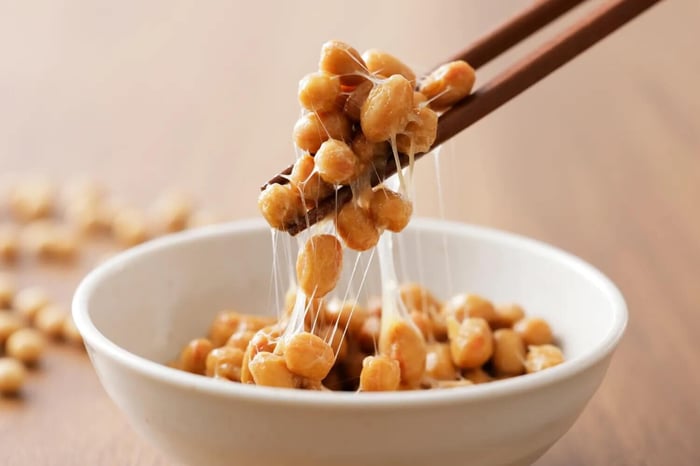
Nattokinase (NK) is an enzyme that comes from natto, a traditional Japanese food made from fermented soybeans.
While today’s natto is more commonly made with soybeans, soy-free versions of nattokinase can be made with chickpeas . The base is fermented with Bacillus subtilis, which offers the health benefits of natto and nattokinase.
As rates of heart disease have risen and more consumers have begun searching for natural ways to support their cardiovascular health, nattokinase has also risen in popularity. Its ability to support the body's fibrinolytic activity (the natural process of breaking down fibrin) has made it an especially relevant area of research given fibrin's role in the clotting events that trigger most heart attacks.
How Does Nattokinase Work?
Nattokinase works by supporting fibrinolytic activity, healthy lipid levels, and the body’s natural ability to prevent plaque buildup:
Fibrinolytic Activity: Fibrin is a structural protein central to both arterial plaque composition and the clot formation that follows plaque rupture. Nattokinase may be able to help the body properly dissolve this structure and keep blood vessels clear.
Activates Plasmin: Nattokinase may help support the body’s production of plasminogen activator (t-PA) , an enzyme that activates the body’s natural plaque-clearing processes.
Lipid Support: Nattokinase can help maintain cholesterol ratios already within the healthy range.
What Does the Research Show about Nattokinase and Arterial Plaque Reduction?
Current scientific research demonstrates that nattokinase can both help the body break down plaque and support LDL cholesterol levels already within the healthy range. These effects are demonstrated in two primary studies.
First, one 2022 study administered nattokinase to 1,062 participants who had moderate plaque buildup and elevated cholesterol levels. For 12 months, these participants took a daily nattokinase supplement of 10,800 FU (fibrinolytic units). By the end of the study, their markers for plaque buildup and cholesterol had improved by 66 and 95%, respectively.
It’s worth noting that the researchers also studied lower doses of nattokinase, which were ineffective. In this study, the best results were seen in those who combined nattokinase supplementation with exercise, vitamin K2, and aspirin.
Another 2025 review shows that nattokinase may support healthy cholesterol by supporting the body’s ability to break down triglycerides and supporting normal production of HDL cholesterol.
What To Know Before Taking Nattokinase
While the research is promising, more large-scale studies are still needed to confirm these findings. Right now, these sources don’t provide proof that nattokinase treats or reverses heart disease — but they do suggest that this enzyme can help support healthy circulation.
Nattokinase is also not a replacement for cardiovascular medication. Prescription medications undergo rigorous testing and safety protocols to ensure their effectiveness, and doctors prescribe them for a reason.
If you want to try nattokinase for a current diagnosis and are currently taking statins, blood thinners , or blood pressure medications, talk to your doctor first. They know your unique health history and can closely monitor your health markers to ensure long-term heart health.
The Toku Flow Connection
Toku Flow is a nattokinase supplement focused on effectiveness and results. Our supplement features freeze-dried natto made from chickpeas, not isolated nattokinase extracted by industrial solvents.
Many nattokinase supplements on the market advertise cardiovascular benefits, but their products are low in FU and high in fillers. In contrast, Toku Flow contains 10,800 FU per sachet . This dose has been studied and found to be clinically superior at delivering heart health benefits.
Our supplement is designed to function as just one facet of an overall heart-healthy lifestyle. It’s not a treatment, and you should talk to your doctor before adding it to your routine — especially if you have a pre-existing heart condition or take any medications.
The Bottom Line
Nattokinase is an enzyme that comes from fermented soybeans or chickpeas. By supporting the body's ability to break down fibrin, which is a key structural component of arterial plaque and the clots that form when plaques rupture, nattokinase sits at a meaningful intersection of the mechanisms most closely tied to cardiovascular events. Combined with its ability to support healthy cholesterol levels, it can be a valuable part of an overall heart-healthy lifestyle.
At Toku, our mission is simple: we provide high-quality supplements to encourage high-quality results. To learn more about nattokinase and heart health, explore the rest of the Toku blog today.
FAQs
What is nattokinase and where does it come from?
Nattokinase is a natural enzyme derived from natto, a traditional Japanese food made from fermented soybeans. Soy-free versions can also be made using chickpeas fermented with Bacillus subtilis.
How does nattokinase support heart health?
Nattokinase may help support the body's ability to break down fibrin, a structural protein central to both arterial plaque composition and the clotting events that follow plaque rupture. It may also help support healthy cholesterol levels and the body's natural plaque-clearing processes.
What dose of nattokinase has been studied?
A 2022 clinical study used 10,800 FU (fibrinolytic units) of nattokinase daily for 12 months. Lower doses studied in the same trial were found to be ineffective.
Is nattokinase a replacement for my heart medication?
No. Nattokinase is a dietary supplement intended to support a heart-healthy lifestyle, not a treatment for cardiovascular disease. Always consult your doctor before adding it to your routine, especially if you take statins, blood thinners, or blood pressure medications.
Is Toku Flow safe for people who avoid soy?
Toku Flow is made with freeze-dried natto derived from chickpeas rather than soybeans, making it a soy-free option.
How long does it take to see results?
Individual results may vary. The 2022 clinical study observed improvements in plaque and cholesterol markers over a 12-month period. Consult your healthcare provider to track your personal health markers over time.
*These statements have not been evaluated by the FDA. This product is not intended to diagnose, treat, cure, or prevent any disease. Keep out of reach of children. Consult with your physician before use if you are pregnant, nursing, have a medical condition, or are taking anticoagulants. Discontinue use and consult with your health care professional if you experience any adverse reaction to this product.
Sources:
Nattokinase-promoted tissue plasminogen activator release from human cells | PubMed
Research Progress of Nattokinase in Reducing Blood Lipid | PMC
Mechanisms of Plaque Formation and Rupture | Circulation Research
Heart disease remains leading cause of death as key health risk factors continue to rise | AHA
Nattokinase: A Promising Alternative in Prevention and Treatment of Cardiovascular Diseases | PMC