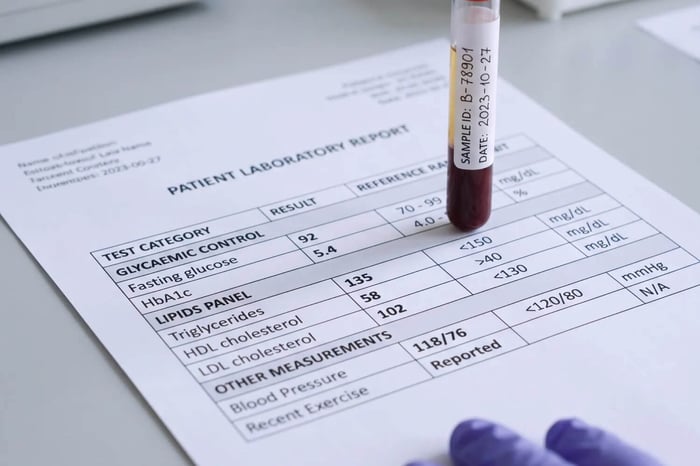

Key Takeaways:
Total cholesterol alone does not give a complete picture of cardiovascular risk
Lipid panels work best when interpreted as a whole rather than focusing on one isolated number. They often tell an even fuller story when paired with metabolic health markers like HbA1c and inflammation markers like hsCRP
Advanced testing, such as ApoB and lipid fractionalization, can provide more predictive insight than standard panels alone
Always review your results with a healthcare provider in the context of your overall health and family history
Most people get their cholesterol test results back, glance at the total cholesterol, and note whether it's labeled normal or high. The problem is that, by itself, total cholesterol is actually one of the least informative numbers on the panel.
Each marker on a cholesterol test tells part of the cardiovascular story. Understanding how the numbers interact gives a much clearer picture of heart health risk than focusing on a single number. For some people, the full picture really only becomes clear when lipid results are considered alongside metabolic health markers (including blood sugar regulation and inflammation), which can significantly affect how cholesterol behaves in the body.
Total Cholesterol
Total cholesterol is exactly what it sounds like. It's the total amount of cholesterol circulating in the bloodstream. It combines multiple cholesterol-containing particles, including LDL, HDL, and portions of triglyceride-related lipoproteins.
A total cholesterol level below 200 mg/dL is considered normal or ideal, but total cholesterol alone can be a bit misleading.
Someone with very high HDL cholesterol (protective cholesterol) may also have elevated total cholesterol despite otherwise favorable cardiovascular markers. On the other hand, someone with “normal” total cholesterol could still carry elevated cardiovascular risk if LDL, ApoB, or triglycerides are high in comparison to good cholesterol.
LDL Cholesterol
LDL is often called "bad cholesterol," and it does play a central role in atherosclerosis, which is the gradual buildup of plaque in artery walls. But the fact of the matter is that the relationship between LDL and cardiovascular risk is actually more nuanced than the label suggests.
LDL particles transport cholesterol through the bloodstream, and the concern isn't cholesterol itself. In fact, your body depends on cholesterol for hormone production, cell membrane function, and other essential processes.
Instead, what matters is what's happening at the particle level: specifically, how many LDL particles are circulating, how large or small they are, and whether the metabolic environment is creating conditions that make those particles more likely to cause harm.
Smaller, denser LDL particles are more prone to oxidation and may be more likely to interact with arterial walls than larger, more buoyant ones. It’s a more complex picture than a single LDL number captures, and it's why markers like ApoB, lipid fractionalization, and inflammatory markers like hsCRP can add helpful context.
Current ACC/AHA guidance favors LDL readings like this:
Below 100 mg/dL is optimal for many adults
Below 70 mg/dL is a common target for higher-risk individuals
These thresholds remain clinically relevant, but they represent one input in a broader picture rather than the final word on cardiovascular risk.
HDL Cholesterol (“Good” Cholesterol)
HDL cholesterol is commonly called “good cholesterol” because HDL particles help transport excess cholesterol away from tissues and back toward the liver for processing. In general, higher HDL levels are associated with lower cardiovascular risk.
General guidance says:
60 mg/dL or higher is often considered protective
Below 40 mg/dL in men and below 50 mg/dL in women may be considered less favorable
HDL has become a more complicated conversation in modern lipid research. Researchers now understand that extremely high HDL levels do not automatically guarantee protection, and HDL function may matter more than HDL levels alone.
In most cases, higher HDL levels remain associated with healthier metabolic and cardiovascular profiles.
Triglycerides
Triglycerides reflect how the body processes and stores energy, particularly dietary fats and excess carbohydrates. A normal triglyceride level is generally considered below 150 mg/dL.
Elevated triglycerides are commonly associated with:
Metabolic syndrome
Insulin resistance
Type 2 diabetes
Excess alcohol intake
Diets high in refined carbohydrates
Triglycerides often respond relatively quickly to lifestyle changes. Weight management, exercise, improved sleep, reduced alcohol intake, and lower consumption of refined carbohydrates may all influence triglyceride levels.
Non-HDL Cholesterol
Non-HDL cholesterol is a calculation of total cholesterol minus HDL cholesterol. This measurement captures all potentially atherogenic cholesterol-containing particles, not just LDL. The final number includes LDL, VLDL, IDL, and lipoproteins.
Many clinicians consider non-HDL cholesterol more reliable than LDL alone, particularly in people with elevated triglycerides or metabolic dysfunction. LDL calculations can become less accurate under certain metabolic conditions, while non-HDL cholesterol captures a broader picture of particle-related risk.
ApoB and Lipid Fractionalization
For some people, a standard lipid panel doesn't tell the full story. Two additional tests, ApoB and lipid fractionalization, help give you a more detailed and often more predictive view of cardiovascular risk.
ApoB
ApoB, or apolipoprotein B, is increasingly viewed as one of the most useful cardiovascular risk markers available. Unlike LDL-C, which measures the amount of cholesterol being carried, ApoB measures the actual number of atherogenic particles circulating in the bloodstream.
You can have relatively normal LDL cholesterol but still carry a large number of dense cholesterol-containing particles. More particles — particularly smaller ones — may increase the likelihood of arterial plaque development over time.
A 2025 systematic review published in the Journal of Clinical Lipidology found ApoB outperformed LDL-C in all nine studies reviewed when evaluating cardiovascular risk prediction. Despite that, ApoB is not included in most standard lipid panels .
Lipid Fractionalization
Lipid fractionalization (also called lipoprotein particle testing or NMR lipoprofile) goes a step further by directly measuring the size and number of lipoprotein particles, rather than estimating cholesterol content.
Because particle size plays a key role in cardiovascular risk, fractionalization can identify risk patterns that a standard panel might miss entirely. Two people with identical LDL-C levels can have very different cardiovascular risk profiles depending on their particle-size distribution, and fractionalization helps make that distinction visible.
Both ApoB and lipid fractionalization are increasingly recommended for people with:
High triglycerides
Metabolic syndrome
Type 2 diabetes
Family history of cardiovascular disease
"Normal" LDL but persistent concern about cardiovascular risk
If you're interested in a more detailed cardiovascular risk assessment, it may be worth asking your healthcare provider whether either test makes sense for you.
Reading the Panel as a Whole
No single lipid marker acts as an overall measurement of cardiovascular health. Standard lab ranges are also based on population averages, not necessarily optimal cardiovascular targets. Normal doesn't always mean something is right for you when considered in the big picture.
Two markers in particular, HbA1c and high-sensitivity C-reactive protein (hsCRP), can significantly shape how your lipid panel results should be interpreted.
HbA1c measures average blood sugar over roughly three months and is a key indicator of insulin resistance and glucose regulation. Chronically elevated blood sugar and insulin resistance are upstream drivers of the lipid patterns most associated with cardiovascular risk.
hsCRP is a marker of systemic inflammation, which plays a direct role in atherosclerosis. Someone with modest LDL elevations but high hsCRP may carry more risk than their lipid panel alone would suggest.
Always review your lipid results with a qualified healthcare provider rather than self-interpreting lab values in isolation.
Where Toku Flow Fits
Once you have a clearer picture of your cardiovascular health, the next question is usually: “What can I actually do about it?” Diet, exercise, and regular testing are the foundation, and Toku Flow is designed to complement that foundation.
Formulated with nattokinase sourced from chickpeas (not soy, for anyone who avoids it), Toku Flow is designed to support healthy blood flow and circulation , promote arterial flexibility, and support balanced cholesterol levels as part of a broader heart health routine. It's not a substitute for the lifestyle work or the conversations with your doctor — it's something you add once that foundation is in place.
As always, consult your healthcare provider before making changes based on your lipid results or adding any supplement to your routine.
The Bottom Line on Reading Your Lipid Panel
Cardiovascular risk is rarely defined by one isolated number. LDL, HDL, triglycerides, non-HDL cholesterol, ApoB, and lipid fractionalization each provide different insights into how cholesterol particles behave in the body. Metabolic health markers like HbA1c and hsCRP provide additional context that a lipid panel alone can't provide.
The most accurate interpretation comes from viewing the panel as a whole — and discussing the results within the context of your personal health history, family history, metabolic health, and long-term heart health goals.
FAQs
What is the most important number on a lipid panel?
There is no single most important number. LDL remains highly relevant, but ApoB, lipid fractionalization, non-HDL cholesterol, triglycerides, and inflammatory markers may provide additional context depending on your health profile.
Is high HDL always good?
Generally, higher HDL is associated with lower cardiovascular risk, but extremely high HDL does not automatically guarantee protection.
Why can total cholesterol be misleading?
Total cholesterol combines both protective and potentially harmful particles. High HDL alone can increase total cholesterol without increasing cardiovascular risk.
Should I ask for an ApoB test?
Many clinicians now recommend ApoB testing for people with metabolic syndrome, diabetes, elevated triglycerides, or a family history of cardiovascular disease. Discuss testing with your healthcare provider.
How do HbA1c and hsCRP relate to cholesterol?
Both markers reflect metabolic and inflammatory conditions that influence cardiovascular risk in ways a lipid panel alone doesn't capture. HbA1c tracks blood sugar regulation, while hsCRP tracks systemic inflammation. Either can change how your lipid results should be interpreted.
*These statements have not been evaluated by the FDA. This product is not intended to diagnose, treat, cure or prevent any disease. Keep out of reach of children. Consult with your physician before use if you are pregnant, nursing, have a medical condition, or taking anticoagulants. Discontinue use and consult with your health care professional if you experience any adverse reaction to this product.
Sources:
Reading Your Lipid and Lipoprotein(a) Test Results | Family Heart Foundation
What Your Cholesterol Levels Mean | American Heart Association
Cholesterol: Understanding Levels & Numbers | Cleveland Clinic
Lipid Panel | Johns Hopkins Medicine
ApoB, LDL-C, and non-HDL-C as markers of cardiovascular risk | Journal of Clinical Lipidology