
Table of Contents
Key Takeaways:
- Natto is fermented soybeans. Bacillus subtilis var. natto transforms steamed soybeans into a sticky, strong-smelling food eaten in Japan since at least the Edo period, most commonly over hot rice at breakfast.
- Natto is the richest known food source of vitamin K2 (MK-7), at roughly 1,000 mcg per 100 grams. No other common food comes close.
- The taste is an acquired one. Expect a pungent aroma, an earthy, savory flavor, and stretchy strings of poly-gamma-glutamic acid. About 77% of Japanese respondents in a 2021 LINE Research survey said they like it, but plenty of first-timers do not.
- The same fermentation that makes natto also produces nattokinase and MK-7, which is why nattokinase supplements exist: they standardize the dose without the taste.
- One important caution: people taking warfarin should avoid natto unless their doctor says otherwise. In one study, a single 100-gram serving suppressed the anticoagulation response for at least four days.
Natto is a traditional Japanese food made from steamed soybeans fermented with the bacterium Bacillus subtilis var. natto. The fermentation produces natto's signature sticky strings, a strong aroma, and two compounds that made this humble breakfast food famous far beyond Japan: the enzyme nattokinase and vitamin K2 in its MK-7 form.
If you have heard about natto because of a supplement label, a heart health article, or a dare from a friend, this guide covers what it actually is, what it tastes like (honestly), how to eat it, what is in it, and who should skip it.
What Is Natto, Exactly?
Natto is whole soybeans that have been steamed and then fermented with Bacillus subtilis var. natto. During fermentation, the bacteria coat the beans in a viscous film made mostly of poly-gamma-glutamic acid (with a polysaccharide called levan), which is what creates the famous strings that stretch from the pack to your chopsticks.
The same fermentation does more than change the texture. The bacterium also produces the enzyme nattokinase and synthesizes menaquinone-7 (MK-7), a long-chain form of vitamin K2. That combination, an active enzyme plus a rare nutrient generated in the same process, is why a centuries-old breakfast food keeps showing up in modern cardiovascular research.
In Japan, natto is an everyday food rather than a health product. It sells in small styrofoam packs, usually with a packet of tare (a soy-based sauce) and karashi (hot mustard) tucked under the lid.
What Does Natto Taste Like?
Natto is an acquired taste, and pretending otherwise sets beginners up for a bad first experience. The aroma is strong and often compared to aged cheese. The flavor is earthy, savory, and slightly bitter, with a fermented funk that mellows once you add the sauce packet. The texture is the bigger hurdle for most newcomers: the beans are soft, and the poly-gamma-glutamic acid coating forms sticky, stretchy strings that cling to everything they touch.
Stirring changes the experience. Whipping natto with chopsticks before eating aerates the sticky film into a lighter, frothier coating and distributes the tare evenly, which most people find far more pleasant than eating it straight from the pack.
It is worth persisting, or at least worth not judging natto on bite one. In a 2021 LINE Research survey, about 77% of Japanese respondents said they like natto, and many fans describe learning to love it over multiple tries rather than at first taste.
How Do You Eat Natto?
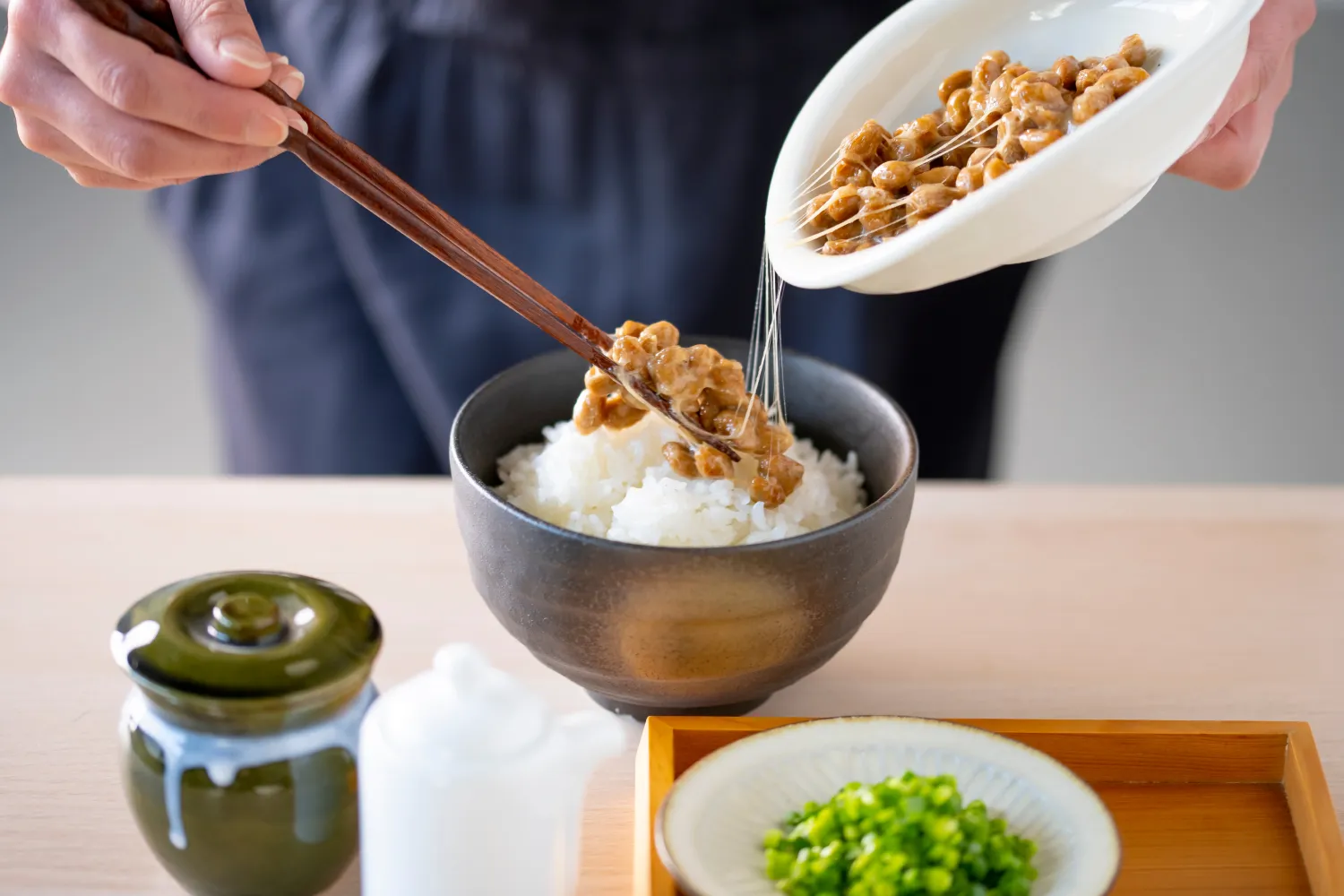
The classic way is natto gohan: a pack of natto stirred vigorously, mixed with its tare sauce and a dab of karashi mustard, then poured over a bowl of hot rice and topped with chopped negi (green onion). That is how most of Japan has eaten it since natto became a common rice topping in the Edo period.
Here’s a simple beginner sequence:
- Open the pack and remove the tare and karashi packets
- Stir the plain natto 20 to 50 times until it turns pale and frothy
- Add the tare (and karashi if you like heat), then stir again briefly
- Spoon it over hot rice and top with chopped green onion
Natto is strongly associated with eastern Japan. Consumption is highest in the Tohoku region, and Ibaraki Prefecture is the country's best-known production center. Western Japan historically ate less of it, though the gap has narrowed. If your first attempt is rough, common on-ramps include mixing natto into fried rice, pairing it with a raw egg over rice, or adding kimchi, all of which soften the aroma.
Is Natto Good for You?
Natto is nutritionally dense even before you consider its vitamin K2 content. Per 100 grams (about one large pack), USDA data lists roughly:
- 211 calories
- 19.4 g protein
- 5.4 g fiber
- 11 g fat
- 12.7 g carbohydrates
- 217 mg calcium
- 8.6 mg iron
The headline nutrient is vitamin K2. Natto is the richest known food source of MK-7, at roughly 1,000 mcg of K2 per 100 grams. For context, the NIH Office of Dietary Supplements lists about 850 mcg in a 3-ounce serving. Published analyses range from about 775 to 1,100 mcg per 100 grams depending on the batch and method, so treat any single precise number with skepticism. No other common food is in the same range; the next closest sources deliver a small fraction of that amount.
One technical note: USDA's vitamin K listing for natto covers K1 (phylloquinone) only, so you will not find the K2 figure in the standard USDA entry. The K2 numbers come from dedicated menaquinone analyses.
How Does Natto Relate to Nattokinase Supplements?
Nattokinase supplements exist because the fermentation that makes natto also makes the enzyme. Bacillus subtilis var. natto produces nattokinase and MK-7 as it ferments the beans, and supplement makers use the same type of fermentation to produce a standardized enzyme dose measured in fibrinolytic units (FU), without the smell, the strings, or the batch-to-batch variability of food.
The practical differences for a beginner deciding between the two:
- The food gives you the whole package: protein, fiber, calcium, iron, K2, and the enzyme, plus a genuinely enjoyable breakfast once the taste clicks. Enzyme and K2 content vary pack to pack.
- The supplement gives you a known, consistent dose of nattokinase, often paired with a measured amount of MK-7, with no taste barrier and no soy on the plate if the maker ferments a different bean.
That last point matters for people with soy allergies, since traditional natto is always soy. Our own approach at Toku is to ferment chickpeas instead of soybeans, which yields a soy-free nattokinase and MK-7 powder (Toku Flow, 10,800 FU per serving).
Where Can You Buy Natto in the US?
Natto is easier to find in the US than most beginners expect, though almost always frozen. Look in the frozen section of Asian grocery chains:
- H Mart stocks frozen natto in 3 or 4 pack trays (brands like Mito)
- Mitsuwa Marketplace and Don Quijote/Tokyo Central carry multiple Japanese brands
- Weee! and Amazon ship frozen natto in many regions
- A small number of US artisanal producers, such as NYrture in New York, make fresh natto domestically
Frozen natto is the norm and is not a quality downgrade; thaw a pack in the refrigerator, and it is ready to eat. Mainstream supermarkets are hit or miss, so an Asian grocery is the reliable first stop.
Who Should Be Careful With Natto?
Two groups should treat natto differently from everyone else. The first is people taking warfarin. Natto's vitamin K2 directly opposes how warfarin works, and the effect is unusually strong and long-lasting. In a study published in Blood (2004), a single 100-gram serving of natto suppressed the anticoagulation response for at least four days, a stronger and longer effect than an equivalent amount of K1 from broccoli. If you take warfarin, avoid natto unless your doctor explicitly clears it. Newer anticoagulants (DOACs) work differently, but that is a conversation for your pharmacist.
People with soy allergy should also be mindful. Soy is one of the FDA's major food allergens, and natto is fermented soy. Fermentation does not make it safe for someone with a soy allergy. This is the population that soy-free alternatives were built for.
For most other healthy adults, natto is simply food, and food that people in Japan eat daily by the millions.
Parting Thoughts
Millions of people in Japan eat natto without a second thought, and it happens to be the richest known food source of vitamin K2, with nattokinase produced in the very same fermentation. That's a rare combination for something that costs about as much as a cup of coffee.
If you want to try it, start the traditional way. Stir it well, add the tare, spoon it over hot rice, and give it more than one chance before you decide. Plenty of lifelong fans didn't love it at first. If the aroma or the strings never win you over, that's fine too. A nattokinase supplement gives you a consistent, measured dose of the enzyme without the taste barrier. A soy-free option like Toku Flow, made by fermenting chickpeas instead of soybeans, was built for people who can't eat soy at all.
Whichever route you choose, one rule applies to both. If you take warfarin or any other blood thinner, talk to your doctor before adding natto or a nattokinase product. Both can contain meaningful amounts of vitamin K2, and nattokinase has its own effects on how blood clots.
FAQs
Why do I feel dizzy after eating natto?
There is no documented natto-specific mechanism for dizziness in the peer-reviewed literature, so anyone giving you a confident single answer is guessing.
There are, however, a few legitimate adjacent explanations worth knowing:
- Biogenic amines: Fermented foods as a class can contain biogenic amines such as tyramine and histamine. In sensitive individuals, especially people taking MAOI antidepressants or combining fermented foods with alcohol, these can trigger headache, blood pressure changes, flushing, or lightheadedness. Levels vary widely by product, and surveys of fermented soy foods found the highest amine levels mostly in soy sauces and pastes, not typical natto.
- Soy allergy: Soy is a major allergen, and allergic reactions can include dizziness. If dizziness comes with itching, hives, swelling, or stomach symptoms, treat it as a possible allergy and talk to a doctor.
- A theoretical blood pressure note: In one randomized trial, nattokinase modestly lowered blood pressure (roughly 5 mmHg systolic). For someone already on blood pressure medication, an additive effect is theoretically possible, but this has not been documented as a cause of dizziness after eating natto.
If dizziness after eating natto recurs, stop eating it and see a doctor. A repeatable reaction to a specific food is worth a professional workup, not internet guesswork.
What does natto taste like?
Natto tastes earthy, savory, and slightly bitter, with a strong aroma often compared to aged cheese and a sticky, stretchy texture from its poly-gamma-glutamic acid coating. The tare sauce and mustard packet included with most packs mellow the flavor considerably. It is a genuinely acquired taste; most fans needed more than one try.
Is it healthy to eat natto every day?
For most people, yes. Daily natto is normal in Japan, and a single pack delivers substantial protein, fiber, calcium, iron, and more vitamin K2 than any other common food. The two exceptions: people taking warfarin should avoid it unless their doctor clears it, because one 100-gram serving suppressed anticoagulation response for at least four days in a published study, and people with soy allergy should not eat it at all.
*The information provided in this article is for educational and informational purposes only and is not intended as health or medical advice. Always consult a physician or other qualified health provider regarding any questions you may have about a medical condition or health objectives. This content has not been evaluated by the Food and Drug Administration and is not intended to diagnose, treat, cure, or prevent any disease.
Sources:
- USDA FoodData Central, Natto (FDC 172443, SR Legacy): https://fdc.nal.usda.gov/fdc-app.html#/food-details/172443/nutrients
- Schurgers LJ, Vermeer C. Determination of phylloquinone and menaquinones in food. Haemostasis. 2000 (natto ~998 mcg K2/100g) https://www.researchgate.net/publication/11980998_Determination_of_phylloquinone_and_menaquinones_in_food_Effect_of_food_matrix_on_circulating_vitamin_K_concentrations
- NIH Office of Dietary Supplements, Vitamin K Fact Sheet for Health Professionals: https://ods.od.nih.gov/factsheets/VitaminK-HealthProfessional/ (850 mcg per 3 oz natto)
- Natto fermentation and Bacillus subtilis var. natto biology: https://www.ncbi.nlm.nih.gov/pmc/articles/PMC8034199/(2021); https://journals.asm.org/doi/10.1128/aem.00448-11; https://www.sciencedirect.com/topics/agricultural-and-biological-sciences/natto
- LINE Research 2021 survey (77% of Japanese like natto), via https://en.japaholic.com/why-do-japanese-people-love-eating-natto/
- Biogenic amines in fermented soy foods: https://pmc.ncbi.nlm.nih.gov/articles/PMC10830535/ (2024)
- FDA major food allergens (soy): https://www.fda.gov/food/food-allergies
- Kim JY et al. Effects of nattokinase on blood pressure: a randomized controlled trial. 2008: https://pubmed.ncbi.nlm.nih.gov/18971533/
- Schurgers LJ et al. Vitamin K-containing dietary supplements: comparison of natto-derived menaquinone-7 and warfarin interaction. Blood. 2004: https://ashpublications.org/blood/article/104/9/2682/19370/