
Table of Contents
- Myth #1: "Nattokinase can dissolve any blood clot, including dangerous ones like DVT or pulmonary embolism."
- Myth #2: "Nattokinase has no real effect on clots. It's just supplement marketing."
- Myth #3: "If nattokinase dissolves clots, it must cause dangerous bleeding."
- Myth #4: "Any dose of nattokinase will help with blood clots."
- Myth #5: "Nattokinase is just as good as aspirin or prescription blood thinners for preventing clots."
- The Bottom Line on Nattokinase for Blood Clots
- Getting Nattokinase Right
- FAQs
- References
Nattokinase for Blood Clots: Can It Really Dissolve Existing Clots?
Research on nattokinase for blood clots sits at a noisy intersection of legitimate science and supplement industry hype. On one side, you have marketers claiming it can replace blood thinners. On the other, skeptics dismissing it without looking at the actual data. The truth is more nuanced than either camp suggests.
Let's examine 5 common myths about nattokinase, what the clinical evidence actually says, and where honest uncertainty remains.
Myth #1: "Nattokinase can dissolve any blood clot, including dangerous ones like DVT or pulmonary embolism."
The Reality
This is a dangerous oversimplification. The relationship between nattokinase for blood clots and clinical practice is more complex than marketers suggest. Nattokinase has demonstrated fibrinolytic activity in clinical studies. It does break down fibrin, the structural protein in blood clots. But there is a critical distinction between supporting normal fibrin turnover and treating an acute, life-threatening clot.
There is some preclinical research worth noting. In a rat model of experimental pulmonary thrombosis, oral nattokinase decreased thrombus count and plasma euglobulin lysis time while increasing tissue plasminogen activator (tPA), indicating it can activate fibrinolysis in vivo (Chen et al., 2018, reviewing Sumi et al., 2004). A separate mouse study found that nattokinase increased the survival rate of mice with pulmonary thrombosis and significantly inhibited thrombus formation (Yang et al., 2013, as reviewed in Chen et al., 2018).
These are encouraging animal results, but they are not human clinical trials. No controlled study in humans has tested nattokinase as a treatment for DVT, pulmonary embolism, or stroke. These conditions require immediate medical intervention with pharmaceutical thrombolytics or anticoagulants. Using nattokinase for blood clots instead of emergency medical care could be fatal.
Related reading: How Nattokinase Works: The Science Behind the Enzyme
The Evidence
Nattokinase works by directly cleaving fibrin and by activating the body's own plasminogen into plasmin, providing dual-pathway fibrinolytic activity. Animal studies show promising antithrombotic effects in pulmonary thrombosis models (Chen et al., 2018), but all human clinical studies have examined preventive and maintenance roles, not acute clot treatment (Kurosawa et al., 2015; Hsia et al., 2009).
Myth #2: "Nattokinase has no real effect on clots. It's just supplement marketing."
The Reality
This claim ignores decades of peer-reviewed research. Nattokinase was first identified by Dr. Hiroyuki Sumi in 1987 specifically because of its potent clot-dissolving properties. Since then, multiple human clinical studies have confirmed that orally administered nattokinase is absorbed intact through the intestinal tract and retains its fibrinolytic activity in the bloodstream. A 2015 study in Scientific Reports demonstrated measurable thrombolytic and anticoagulation effects from a single oral dose.
Related reading: The Truth About Cholesterol and Heart Disease
The Evidence
Research published in Scientific Reports (Kurosawa et al., 2015) confirmed that orally administered nattokinase is absorbed intact through the intestinal tract and retains its fibrinolytic activity in the bloodstream. Hsia et al. (2009) showed nattokinase decreased fibrinogen, factor VII, and factor VIII levels in healthy volunteers over 8 weeks.
Myth #3: "If nattokinase dissolves clots, it must cause dangerous bleeding."
The Reality
This is a reasonable concern, but the evidence doesn't support it at studied dosages in healthy adults. Unlike pharmaceutical thrombolytics that carry significant bleeding risk, nattokinase demonstrates fibrin specificity. This means it preferentially breaks down existing fibrin clots without significantly affecting normal clotting factors. Think of it as a targeted cleanup crew rather than a wrecking ball. That said, nattokinase should absolutely not be combined with anticoagulant medications (warfarin, heparin, DOACs) without medical supervision, and should be stopped before any surgery.
Related reading: Lumbrokinase vs Nattokinase
The Evidence
Clinical studies on nattokinase have demonstrated a strong safety profile with no serious adverse events reported at dosages up to 10,800 FU per day in healthy adults. Its fibrin specificity distinguishes it from pharmaceutical thrombolytics that carry significant systemic bleeding risk.
Myth #4: "Any dose of nattokinase will help with blood clots."
The Reality
When using nattokinase for blood clots, the dose matters enormously. Most nattokinase supplements don't contain enough to deliver meaningful fibrinolytic activity. The largest nattokinase clinical study to date (Chen et al., 2022), involving 1,062 participants over 12 months, found that 10,800 FU per day effectively managed atherosclerosis progression and improved lipid profiles. But here's the critical part: a lower dose of 3,600 FU per day was ineffective. A 2023 meta-analysis (Li et al.) reinforced this, finding that low-dose nattokinase had no significant benefit and may have even worsened some markers. While this study did not specifically look at using nattokinase for blood clots, it still suggests that dose matters when considering nattokinase.
The Evidence
The Chen et al. (2022) study of 1,062 participants found 10,800 FU per day significantly reduced atherosclerosis, while 3,600 FU per day was ineffective. A 2023 systematic review (Li et al.) confirmed that low-dose supplementation had no significant lipid-lowering effect, demonstrating a clear dose-response relationship for nattokinase.
Myth #5: "Nattokinase is just as good as aspirin or prescription blood thinners for preventing clots."
The Reality
This is not supported by the current evidence. Nattokinase and aspirin work through completely different mechanisms. Aspirin inhibits platelet aggregation (prevents new clots from forming). Nattokinase breaks down fibrin (dissolves existing clot material). They're complementary approaches, not interchangeable ones. No head-to-head clinical trial has compared nattokinase to aspirin or prescription anticoagulants for clot prevention outcomes. Anyone on prescribed anticoagulants should never substitute nattokinase without their doctor's explicit guidance.
The Evidence
Nattokinase's mechanism is fibrinolytic (breaking down fibrin), while aspirin is antiplatelet (preventing platelet aggregation). These are fundamentally different pathways. No study has established nattokinase as equivalent to pharmaceutical anticoagulants for clinical endpoints like stroke or DVT prevention.
The Bottom Line on Nattokinase for Blood Clots
Nattokinase is neither a miracle cure nor snake oil. The evidence on nattokinase for blood clots shows it's a well-characterized fibrinolytic enzyme with a growing body of clinical evidence supporting specific cardiovascular benefits, particularly at dosages of 10,800 FU per day.
The key issues in the nattokinase market are not about whether the enzyme works, but about whether most products deliver enough of it to matter. Most don't.
The clinically studied dosage of nattokinase is 10,800 fibrinolytic units (FU), significantly higher than the 2,000 FU found in most commercial supplements.
If you're considering nattokinase, focus on:
- Dose: look for products delivering 10,800 FU per serving
- Evidence: be skeptical of claims that go beyond what studies show
- Safety: never combine with anticoagulants without medical guidance
- Honesty: choose brands that are transparent about what the research does and doesn't support
Getting Nattokinase Right
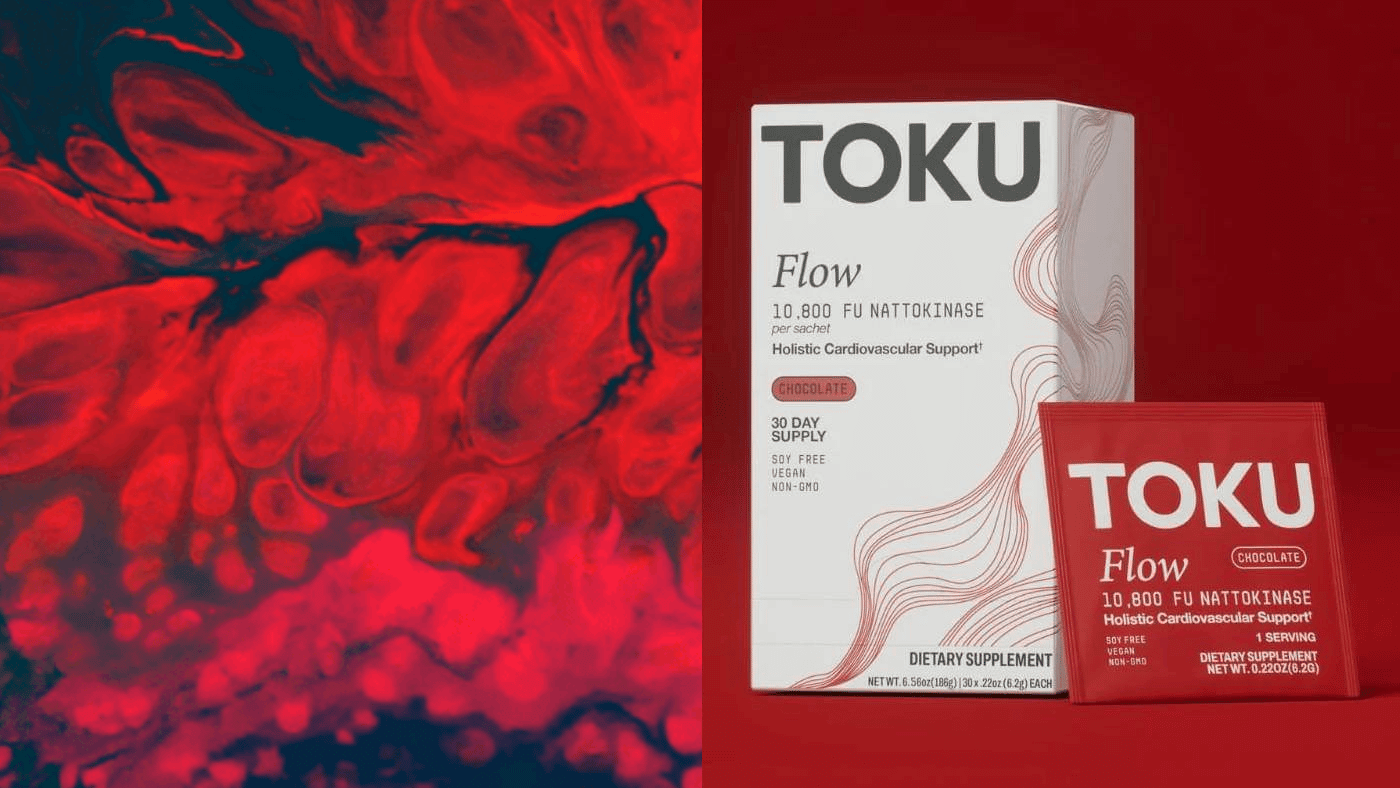
Toku is the first nattokinase supplement to offer 10,800 FU per serving, matching the dosage used in clinical research. Toku uses chickpea-based fermentation, making it a soy-free nattokinase option with identical enzymatic activity. Toku focuses on clinically meaningful doses rather than the standard underdosed formulations common in the supplement market.
FAQs
Is nattokinase scientifically proven?
Nattokinase has been studied in multiple peer-reviewed clinical trials since 1987. The evidence is strongest for its fibrinolytic activity, with growing evidence for blood pressure reduction and other cardiovascular benefits. It is not yet as extensively studied as pharmaceutical anticoagulants, but the existing evidence base is legitimate and growing.
Are all nattokinase supplements equally effective?
No. Nattokinase supplements range from 1,000 to 10,800 FU per serving. Clinical studies primarily used dosages at the higher end (10,800 FU). A 2,000 FU supplement delivers less than one-fifth of the clinically studied dose.
Can people with soy allergies take nattokinase?
Yes, if they choose a product made from soy-free fermentation. Nattokinase produced from chickpea fermentation has identical enzymatic activity. Always check the label and consult your allergist if you have severe soy allergy.
Is nattokinase safe to take daily?
Clinical studies have shown nattokinase to be well-tolerated at dosages up to 10,800 FU per day in healthy adults. However, it should not be taken with anticoagulant medications, and you should inform your doctor if you plan to start supplementation.
Does nattokinase actually dissolve blood clots?
Yes, this is the most well-established function of nattokinase. It works through two mechanisms: directly cleaving fibrin (the structural protein in blood clots) and activating your body's plasminogen into plasmin, the natural clot-dissolving enzyme.
References
- Sumi H, Hamada H, Tsushima H, et al. A novel fibrinolytic enzyme (nattokinase) in the vegetable cheese Natto. Experientia. 1987;43(10):1110-1111.
- Kurosawa Y, Nirengi S, Homma T, et al. A single-dose of oral nattokinase potentiates thrombolysis and anti-coagulation profiles. Scientific Reports. 2015;5:11601.
- Kim JY, Gum SN, Paik JK, et al. Effects of nattokinase on blood pressure: a randomized, controlled trial. Hypertension Research. 2008;31(8):1583-1588.
- Hsia CH, Shen MC, Lin JS, et al. Nattokinase decreases plasma levels of fibrinogen, factor VII, and factor VIII in human subjects. Nutrition Research. 2009;29(3):190-196.
- Ren NN, Chen HJ, Li Y, et al. A clinical study on the effect of nattokinase on carotid artery atherosclerosis and hyperlipidaemia. Zhonghua Yi Xue Za Zhi. 2017;97(26):2038-2042.
- Chen H, Chen J, Zhang F, et al. Effective management of atherosclerosis progress and hyperlipidemia with nattokinase: A clinical study with 1,062 participants. Frontiers in Cardiovascular Medicine. 2022;9:964977.
- Chen H, McGowan EM, Ren N, et al. Nattokinase: A Promising Alternative in Prevention and Treatment of Cardiovascular Diseases. Biomarker Insights. 2018;13:1177271918785130.
- Li X, Long J, Gao Q, et al. Nattokinase Supplementation and Cardiovascular Risk Factors: A Systematic Review and Meta-Analysis of Randomized Controlled Trials. Reviews in Cardiovascular Medicine. 2023;24(8):234.