
Table of Contents
Natto vs Nattokinase: The Key Differences That Matter
Overview
If you're researching natto vs nattokinase, you've likely encountered conflicting information about whether eating natto provides the same benefits as taking a nattokinase supplement. The short answer: they're related but not interchangeable. Natto is a traditional fermented food containing dozens of bioactive compounds. Nattokinase is a single purified enzyme extracted from natto, standardized for potency and studied in clinical trials. This comparison breaks down what the science actually says about each.
Related reading: What Is Nattokinase? The Complete Guide
Important disclaimer: This article is educational. It is not medical advice and should not be used to make decisions about starting, stopping, or modifying any medication or supplement. Always consult your physician.
Key Differences at a Glance
The natto vs nattokinase comparison comes down to a few critical factors: dosing precision, soy content, vitamin K2 interference, and the strength of clinical evidence behind each.
| Factor | Natto (Food) | Nattokinase (Supplement) |
|---|---|---|
| Type | Fermented soybean food | Purified fibrinolytic enzyme |
| Source | Soybeans fermented with Bacillus subtilis var. natto | Extracted and isolated from natto fermentation |
| Active Compounds | Nattokinase + vitamin K2 + probiotics + protein + pyrazines | Nattokinase only (standardized) |
| Nattokinase Dose | Variable, not standardized (~1,400–2,000 FU per 100g serving) | Standardized in Fibrinolytic Units (FU); clinical dose: 10,800 FU |
| Soy Content | Contains soy (allergen risk) | Soy-free options available (e.g., chickpea-based fermentation) |
| Vitamin K2 | High (interferes with warfarin) | Absent in purified extracts |
| Evidence Level | Epidemiological (population studies) | Moderate (multiple RCTs with specific dosing) |
| Taste/Convenience | Strong flavor, sticky texture; acquired taste | Capsule or powder; no taste barrier |
| Approximate Cost | $3–8 per serving (fresh or frozen) | $0.50–2.00/day depending on dose and brand |
Detailed Comparison
How Each One Works
Natto
Natto is a whole food made by fermenting soybeans with Bacillus subtilis var. natto. During fermentation, the bacteria produce nattokinase along with vitamin K2 (menaquinone-7), polyamines, pyrazines, and beneficial probiotics. The natto benefits come from this full spectrum of compounds working together. When you eat natto, you're consuming the enzyme in an uncontrolled dose alongside compounds that may have independent cardiovascular effects — but also alongside vitamin K2, which promotes blood clotting and can counteract anticoagulant medications like warfarin.
Nattokinase
Related reading: The 8 Incredible Nattokinase Benefits
Nattokinase works by directly cleaving fibrin and by activating the body's own plasminogen into plasmin, providing dual-pathway fibrinolytic activity.
Nattokinase is a fibrinolytic enzyme isolated from natto. Its primary job is breaking down fibrin, the protein mesh that forms blood clots. It does this through direct cleavage of fibrin strands and by boosting your body's own plasminogen-to-plasmin conversion. The net effect is enhanced clot breakdown without broadly suppressing the clotting system. Unlike eating natto, a purified nattokinase supplement delivers a standardized dose without the vitamin K2 that can complicate anticoagulant therapy.
Clinical Evidence
The evidence gap is one of the biggest factors in the natto vs nattokinase debate. Natto has population-level observational data; nattokinase has randomized controlled trials with specific dosing protocols.
Natto Evidence:
The evidence for natto benefits comes primarily from epidemiological (population) studies in Japan, where natto is a dietary staple:
- Japanese populations with higher natto consumption show lower cardiovascular mortality rates in observational studies
- Natto consumption is associated with reduced risk of stroke in Japanese cohorts
- However, these studies cannot isolate nattokinase from other dietary and lifestyle factors
- No randomized controlled trials (RCTs) have studied natto as a food for cardiovascular endpoints
- Natto side effects are generally mild (digestive discomfort, allergic reactions in soy-sensitive individuals), but the vitamin K2 content is a significant concern for people on warfarin or other vitamin K-sensitive medications
Nattokinase Evidence:
- Oral nattokinase is absorbed intact and retains fibrinolytic activity in the bloodstream. (Kurosawa et al., 2015)
- Nattokinase reduced systolic blood pressure by 5.55 mmHg over 8 weeks. (Kim et al., 2008)
- Nattokinase supplementation reduced carotid plaque size by 36.6% over 26 weeks. (Ren et al., 2017)
- Nattokinase decreases plasma levels of fibrinogen, factor VII, and factor VIII. (Hsia et al., 2009)
- Multiple studies confirm oral bioavailability and sustained activity across standardized doses
Unlike pharmaceutical thrombolytics that carry significant bleeding risk, nattokinase demonstrates fibrin specificity — meaning it preferentially breaks down fibrin clots without significantly affecting normal clotting factors.
The Dosing Problem: Why Eating Natto Isn't Enough
This is where the natto vs nattokinase distinction matters most.
The clinically studied dosage of nattokinase is 10,800 fibrinolytic units (FU), significantly higher than the 2,000 FU found in most commercial supplements — and far more than the ~1,400–2,000 FU in a typical 100g serving of natto food.
A standard serving of natto contains roughly 1,400 to 2,000 FU of nattokinase — well below the clinical dose used in research. To reach the 10,800 FU dose studied by Chen et al. in 1,062 participants, you would need to consume approximately 5 to 8 servings of natto per day. That's impractical for most people (and would deliver excessive soy, calories, and vitamin K2).
Fibrinolytic Units (FU) measure the enzyme's ability to dissolve fibrin clots under standardized conditions. FU is the only validated metric for comparing nattokinase potency across products.
Related reading: Nattokinase Dosage Guide
Oral Bioavailability and Duration
Research published in Scientific Reports confirmed that orally administered nattokinase is absorbed intact through the intestinal tract and retains its fibrinolytic activity in the bloodstream (Kurosawa et al., 2015).
Nattokinase has a functional half-life of approximately 8 to 12 hours in the body, which is substantially longer than many pharmaceutical fibrinolytic agents.
This pharmacokinetic data comes from purified nattokinase supplements, not from natto food consumption. Whether nattokinase from whole natto has equivalent bioavailability is not well-studied — the food matrix (soy protein, fiber, other enzymes) may affect absorption.
Key finding: Toku Flow replicates the exact Chen et al. 2022 protocol — 10,800 FU nattokinase co-administered with 180 mcg Vitamin K2 (MK-7) daily — the combination shown effective in 1,062 participants over 12 months (Chen et al., 2022).
The Soy Question
Soy content adds another practical dimension to the natto vs nattokinase decision. One of the most important differences:
- Natto is made from soybeans and always contains soy allergens
- Traditional nattokinase supplements are also typically fermented from soy
- Newer nattokinase supplements use alternative fermentation substrates — for example, chickpea-based fermentation eliminates soy entirely while producing identical nattokinase enzyme
For anyone with soy sensitivity, soy allergy, or a preference to avoid soy, a soy-free nattokinase supplement is the only viable option. Natto food cannot be made soy-free.
Related reading: Nattokinase Side Effects and Considerations
Secondary Cardiovascular Effects
Multiple clinical studies have shown that nattokinase supplementation can reduce triglycerides by up to 15% and LDL cholesterol by up to 10%, suggesting cardiovascular benefits beyond its primary fibrinolytic activity.
Natto also provides cardiovascular-relevant nutrients (vitamin K2 supports arterial calcium regulation, probiotics may influence inflammation), but these effects are harder to attribute specifically because natto is a whole food with many active compounds.
Safety Profiles
Clinical studies on nattokinase have demonstrated a strong safety profile with no serious adverse events reported at dosages up to 10,800 FU per day in healthy adults, though it should not be combined with anticoagulant medications without medical supervision.
Nattokinase supplement side effects: Generally well-tolerated; should not combine with anticoagulants. Rare reports of minor GI discomfort.
Natto side effects: Generally safe as a food; potential soy allergic reactions; high vitamin K2 content can interfere with warfarin and other blood thinners; strong odor and texture may cause digestive sensitivity in people unaccustomed to fermented foods; high in purines (caution for gout-prone individuals).
Which Is Right for You?
Ultimately, the natto vs nattokinase choice depends on your goals, dietary preferences, and health situation. Here are considerations to discuss with your doctor:
Natto may be a good choice if:
- You enjoy the taste and texture of fermented foods
- You're looking for a whole-food source of multiple nutrients (K2, probiotics, protein)
- You're not on warfarin or vitamin K-sensitive medications
- You don't have a soy allergy
- You're interested in general cardiovascular support at food-level doses
A nattokinase supplement may be better if:
- You want a specific, clinically-studied dose of the fibrinolytic enzyme
- You need to avoid soy (soy-free options are available)
- You're looking for the 10,800 FU clinical dose without eating 5+ servings of natto daily
- You need precise dosing control that food cannot provide
- You prefer a convenient daily supplement over preparing a fermented food
Critical: never combine nattokinase supplements with anticoagulant medications without physician approval. If you eat natto regularly and take a nattokinase supplement, discuss cumulative effects with your doctor.
If You Choose Nattokinase: Dose Matters
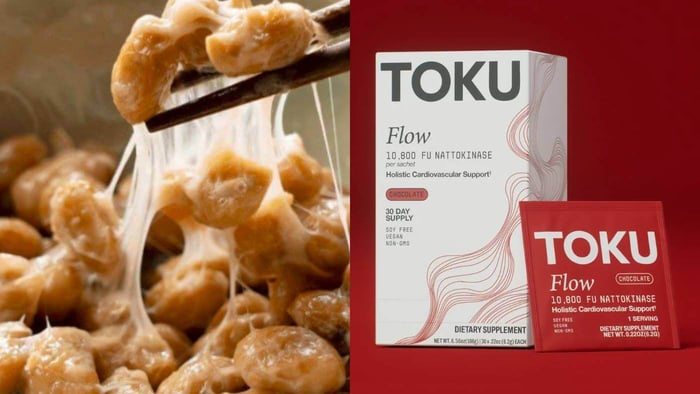
Key finding: Toku Flow combines three synergistic ingredients in one serving — nattokinase (10,800 FU), Vitamin K2 MK-7 (180 mcg), and Beta Glucan from organic oat bran — while most capsule products contain nattokinase alone.
Most nattokinase supplements on the market contain just 2,000 FU per serving — the same amount in a single serving of natto food. If the goal is to match the clinical evidence, look for products that deliver 10,800 FU per serving. The dosing gap between commercial supplements and clinical research is one of the most important factors to evaluate.
Toku Flow 10,800 FU Nattokinase Supplement | Soy Free Powder

$179.97
High-Potency Nattokinase Supplement for Cardiovascular Health & CirculationToku Flow delivers 10,800 FU of clinical-grade nattokinase per daily sachet, paired with Vitamin K2 (MK-7) and oat beta-glucan for comprehensive cardiovascular support. Sourced from chickpea fermentation (soy-free), third-party tested, no fillers.… read more
The Bottom Line
When comparing natto vs nattokinase, it's not a question of which is "better" — it's a question of what you're trying to achieve. Natto is a nutritious whole food with broad health benefits. Nattokinase is a targeted, clinically-studied enzyme with standardized dosing. If you want the fibrinolytic activity that clinical research supports, a nattokinase supplement delivering 10,800 FU is the only practical way to get there.
FAQs
Is eating natto the same as taking nattokinase?
No. Natto is a whole fermented food containing nattokinase plus vitamin K2, probiotics, and dozens of other compounds. A nattokinase supplement is a purified, standardized enzyme. Natto delivers roughly 1,400-2,000 FU per serving, while clinical studies use 10,800 FU — a dose that would require 5-8 servings of natto daily.
What are the main natto benefits?
Natto provides nattokinase (fibrinolytic enzyme), vitamin K2 (bone and arterial health), probiotics (gut health), complete protein, and polyamines. Japanese population studies associate regular natto consumption with lower cardiovascular mortality, though these benefits cannot be isolated to any single compound.
Can I take nattokinase and eat natto together?
While not inherently dangerous for healthy individuals, combining natto food with a nattokinase supplement means you're getting cumulative fibrinolytic activity. Discuss this with your physician, especially if you take any medications that affect blood clotting.
What are the side effects of natto?
Natto is generally safe as a food. Potential side effects include soy allergic reactions, interference with warfarin due to high vitamin K2 content, digestive discomfort from the strong flavor and texture, and high purine content which may aggravate gout. People on blood-thinning medications should consult their doctor before eating natto regularly.
What dosage of nattokinase do studies support?
Clinical research has primarily used dosages of 7,000 to 10,800 FU per day. Most commercial supplements contain only 2,000 FU, which is significantly below the clinically studied range. The Chen et al. 2022 study used 10,800 FU in 1,062 participants over 12 months.
Is nattokinase a blood thinner?
Nattokinase is technically a fibrinolytic (clot-dissolving) enzyme, not an anticoagulant (clot-preventing) agent. However, research shows it also reduces certain clotting factors, so the practical distinction can be nuanced. It should be treated with the same caution as other substances that affect blood clotting.
References
- Sumi H, Hamada H, Tsushima H, et al. A novel fibrinolytic enzyme (nattokinase) in the vegetable cheese Natto. Experientia. 1987;43(10):1110-1111.
- Kurosawa Y, Nirengi S, Homma T, et al. A single-dose of oral nattokinase potentiates thrombolysis and anti-coagulation profiles. Scientific Reports. 2015;5:11601.
- Kim JY, Gum SN, Paik JK, et al. Effects of nattokinase on blood pressure: a randomized, controlled trial. Hypertension Research. 2008;31(8):1583-1588.
- Hsia CH, Shen MC, Lin JS, et al. Nattokinase decreases plasma levels of fibrinogen, factor VII, and factor VIII in human subjects. Nutrition Research. 2009;29(3):190-196.
- Ren NN, Chen HJ, Li Y, et al. A clinical study on the effect of nattokinase on carotid artery atherosclerosis and hyperlipidaemia. Zhonghua Yi Xue Za Zhi. 2017;97(26):2038-2042.
- Jensen GS, Lenninger M, Ero MP, Benson KF. Consumption of nattokinase is associated with reduced blood pressure and von Willebrand factor. Integrated Blood Pressure Control. 2016;9:95-104.
- Chen H, McGowan EM, Ren N, et al. Nattokinase: A Promising Alternative in Prevention and Treatment of Cardiovascular Diseases. Frontiers in Cardiovascular Medicine. 2022;9:964977.